
Skip to content

Cart

Your cart is empty

Continue shopping
La Station, a brick house at the edge of a meadow, in Heks

The atelier · Heks, Limburg

The atelier

At La Station, the old tram station in Heks.
Eight steps between bean and bar, and at each one, a terroir to keep.

A sack of beans reaches us with everything it has taken a year to become: a variety, an altitude, its fermentation, its drying,
and the hands of those who sorted it.

Our job is not to add flavour. It is to lose none of it.

For the cacaos and chocolates we make, everything happens here, in small batches, on machines we run ourselves. No step is handed to anyone else, and no lot is blended so that one year tastes like the next.

Front of La Station, brick house, MOOJO logo on the wall
La Station, Hekslaan, Heks

The place

La Station,
in Heks

A brick house at the edge of a meadow, in Belgian Limburg, twenty minutes from Liège and the same from Hasselt. It was the village's tram station. The name La Station was here before us, and we kept it.

No one comes here for the décor. This is where a terroir is kept, or lost. Some twenty origins pass between these walls each year, one at a time. The drinking cacao, the bars, the pastes, the giandujotti we make: it all comes out of this room, or it does not come out at all.

The production room, at La Station
The production room, at La Station

From bean to bar

Eight gestures,
in this order

01

Reception

The sacks arrive with their lot markings: the origin, the weight, the year. They sleep at a steady temperature, away from light and damp, because a badly kept lot is already a damaged lot. Each origin stays in its own sack, under its own name. From here on, nothing gets mixed by chance.

Reception
02

Sorting & sieving

By hand, we pick out the stones, the fragments, the flat or mouldy beans. The eye keeps returning to the tray, the fingers set aside what must go. This patient work lays the ground for a clean taste.

Hand-sorting beans on a stainless-steel tray
03

Roasting, or not

The oven heats gently, between 110 and 115 °C, or not at all. A heavy roast makes a comfortable chocolate flavour that covers up the lot. A low roast lets through the acidity, the fruit, the bitterness that belongs to the soil of origin. It is more fragile. It is exactly what we are after.

The roasting oven and the racks of bean trays
04

Cracking & winnowing

The bean is cracked, then a current of air carries off the shell and leaves the nibs, those shards of pure cacao. When the lot is small or the shell stubborn, we peel by hand.

Cracking & winnowing
05

Grinding & refining

The nibs go under the stone grinder. Little by little, the dry shards become a liquid mass: it is the bean's own butter being released, nothing is added. Then the grinder keeps turning, for hours on end, until the tongue can no longer feel any grit. For the bars, cane sugar comes in here, always in the minority, in a proportion chosen for each lot.

Stone grinders turning in the cacao mass
06

Maturation

The mass rests. The aromas fall into place, the acidity of the fermentation settles. We keep watch: a resting mass can pale or become covered in white specks without the taste being affected. Knowing how to tell a defect from a natural phenomenon is part of the craft.

Maturation tank, surface of the cacao mass at rest
07

Tempering

Cocoa butter can crystallise in six ways. Only one gives a bar that shines and snaps cleanly. Tempering means imposing that form on it, by gently bringing the temperature down and then back up, between 29 and 31 °C for our dark chocolates, towards the bottom of that range when summer warms the room. It is the least forgiving step: half a degree too high, and the bar turns white three weeks later, at the customer's.

Tabling chocolate with a spatula on the worktop
08

Moulding & resting

We pour the chocolate by hand, mould after mould. We tap the moulds to chase out the bubbles, then leave them to crystallise in the cold. When unmoulded, the bar should come away cleanly. If the result needs reworking, the chocolate goes back to work.

A stream of chocolate pouring into a MOOJO mould
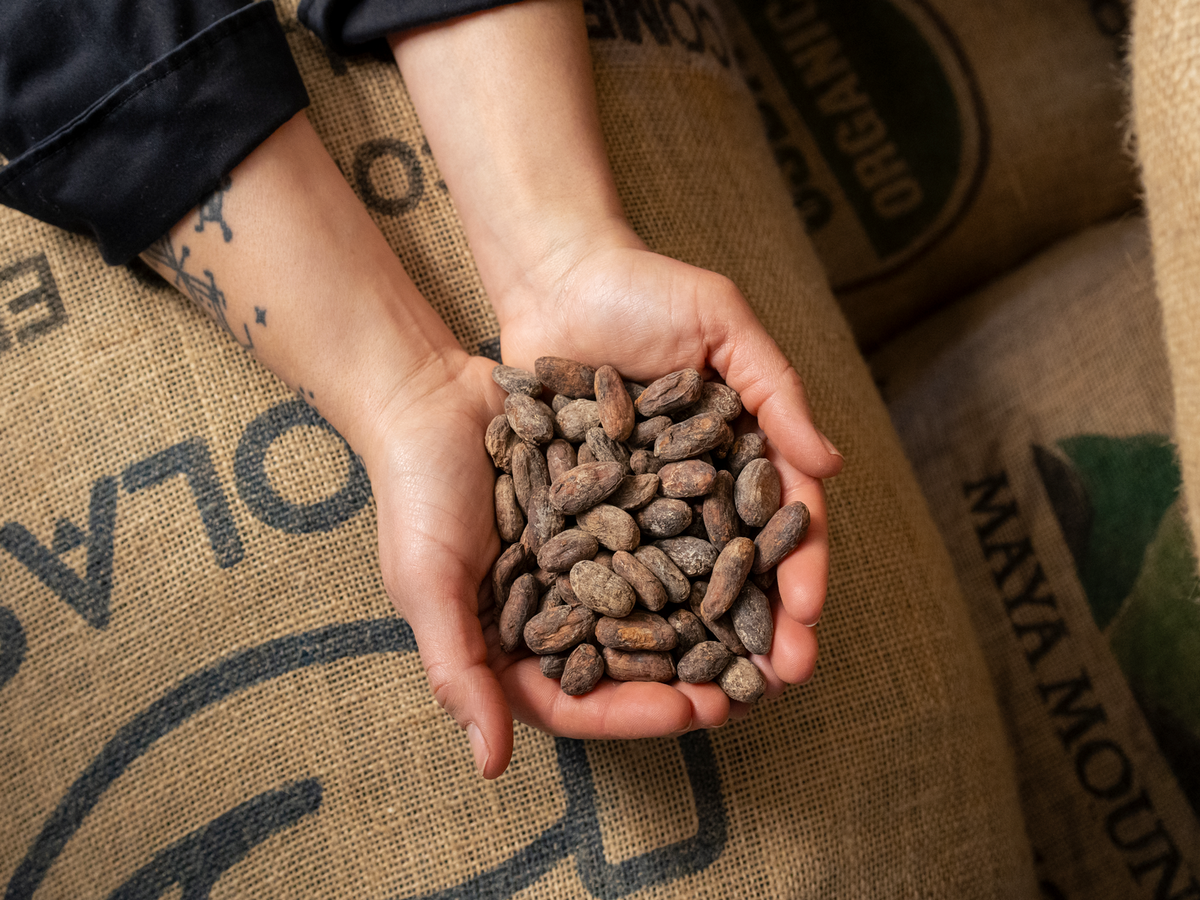
Hands cupped full of cacao beans, above the lot sacks
An origin takes a year to become what it is. It can be lost in twenty minutes of roasting.
MOOJO atelier, Heks
MOOJO polycarbonate moulds, relief pattern visible
A stream of chocolate pouring into a MOOJO mould

In the shop

All the origins

Find the place behind every cacao

See the origins
Tempering setting on the tempering-machine screen
Tempering setting, taken lot by lot

Listening

The decision is in the mouth

None of these steps has a universal setting. A bean from Belize and a bean from Peru do not share the same moisture, the same size or the same shell. The same roast profile will be right for one and flat for the other.

So we taste. The bean, the nibs, the warm mass, the rested mass, then the bar. When the lot no longer tastes like itself, when we cannot find what made us choose it, we change a setting and start again. It is slow. It is the only method we have found that does not lie.

Acidity

Fermentation plays a part in its character. We look at how the acidity shows itself in each lot and how the roast goes along with it: a liveliness to taste, among the other flavours.

Fruit

Banana, citrus, red fruit: a cacao can suggest them on its own. We taste these nuances as the work goes on, paying attention to what the heat does to them.

Texture

Under the stone grinder, the particles grow finer and the paste becomes smoother. We taste it to feel the grain: that is how the hours of grinding take on a shape the tongue can recognise.

The discipline

Four rules that do not move

01

Temperature before schedule

If the room is too warm, we lower the setting or shift production. The atmosphere of the workshop counts in chocolate work as much as the temperature of the chocolate itself.

02

One lot at a time

For single-origin cacaos, we work one lot at a time, from nibs to moulding. Cleaning between two lots costs time. Mixing them would cost the terroir.

03

Time is an ingredient

Nothing is accelerated. Hours of grinding, several days of rest for the mass. That is what we cannot buy more cheaply.

04

Tasting before letting it go

A failed lot does not become a promotion. It goes back into the tank, or it stays here and we eat it. The name of an origin binds those who grew it.

The bar leaves the mould. Its story goes further back,
to the trees and the hands that opened the pods.

Explore the origins