

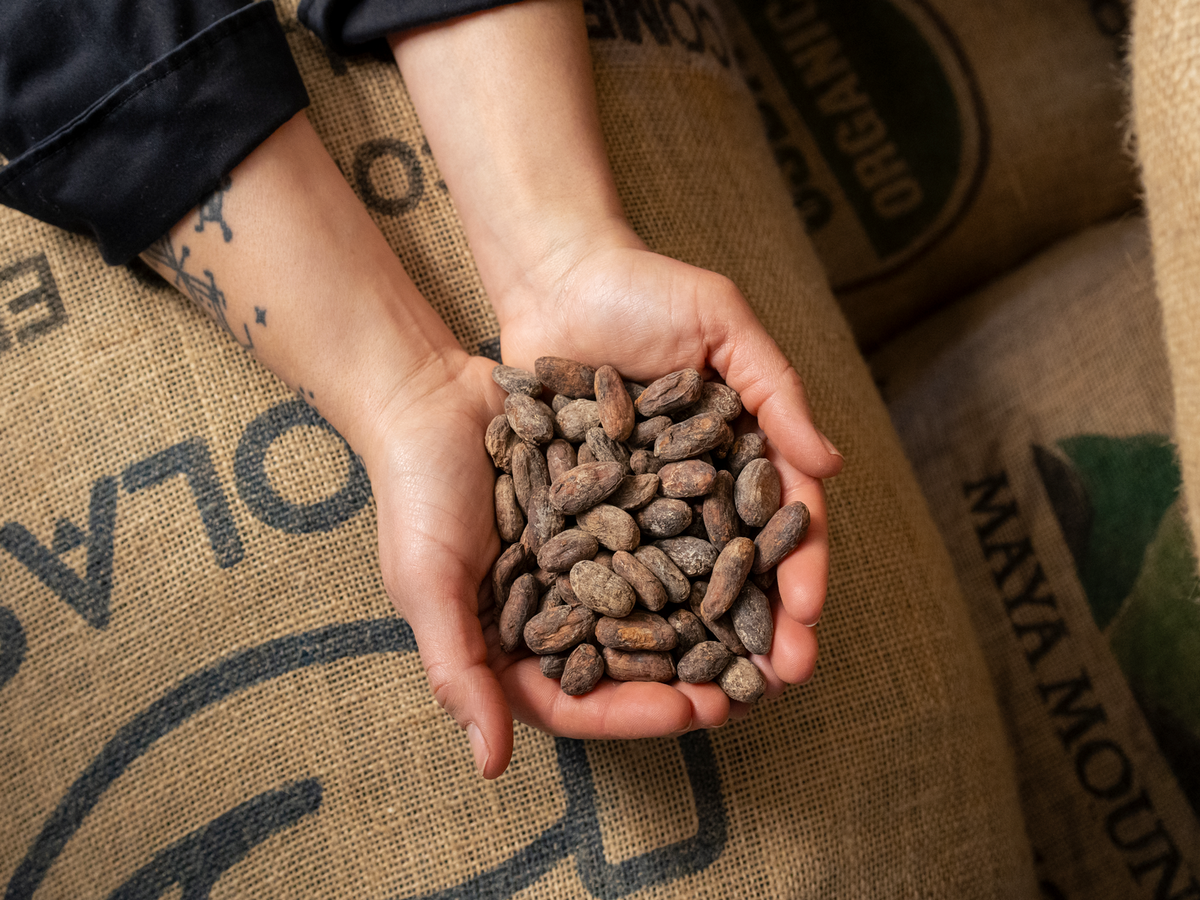
Fermentation before genetics
A poorly fermented Criollo is worth less than a carefully handled Trinitario. Genetics makes a promise; fermentation keeps it or doesn't. It is the first thing we look at in a sample.

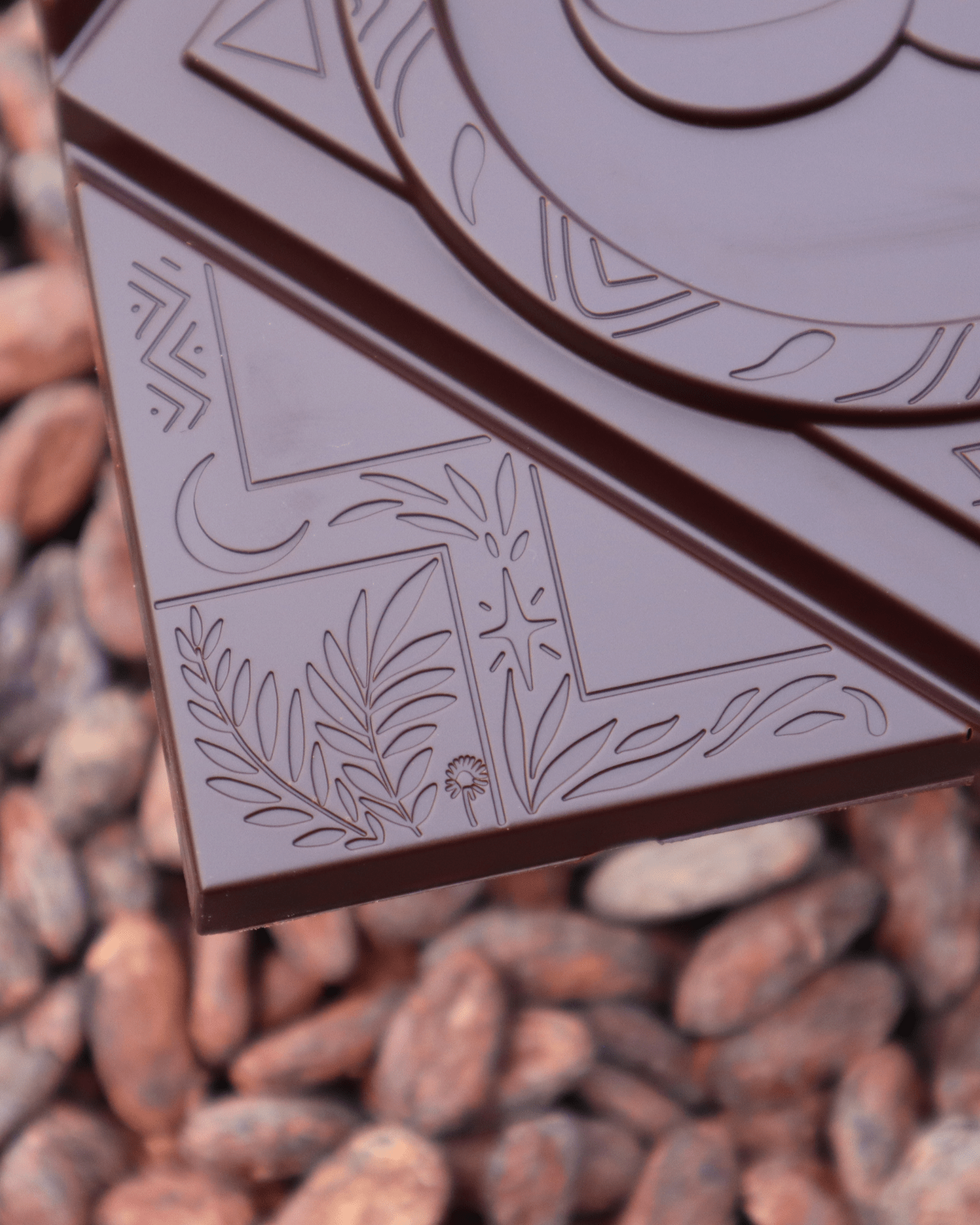
The indulgent bars
Discover our ranges

Our origins
Discover our terroirs

Vegan milk
Majambo, the little known cousin

The approach
One simple idea guides us: a tool, a skill, a relationship is worth more when it is shared.
With a sample in front of us,
we look for the taste of a place and the care of those who worked the harvest.
Fermentation, drying and the price paid are all part of the same choice.
Here is how we choose our cacaos, who we work with, and what we try to hold in common.

The price
Before they reach us, the beans have taken time: harvesting, sorting, guiding the fermentation, waiting out the drying. The price we pay has to make room for that work.
We buy well above the world market price, starting from the real price of a well-worked lot. This is not generosity: it is the cost of the work that makes the flavour.
When the market soared, we froze our retail prices for a year before passing on about 10%. The share meant for the producers stayed intact.
Our criteria
A poorly fermented Criollo is worth less than a carefully handled Trinitario. Genetics makes a promise; fermentation keeps it or doesn't. It is the first thing we look at in a sample.
To choose a lot, we try to get to know its region, the cooperative and the people who saw it through. These ties give a face to the cacao we work with.
A cacao that needs another to be good will not be sold as a single origin. When we blend, and it does happen, it is a choice, and it is called what it is.
We buy volumes we can store and transform while the lot keeps its qualities. The size of what we buy follows the size of our work in Heks.

With whom
Between a distant cooperative and our workshop, there is often someone who makes the link. Depending on the origin, that is Uncommon Cacao, Cacao Latitudes, Silva Cacao, Crafting Markets or Nahù, and sometimes relationships built on the ground.
Producer organisations have their own place: Norandino brings families together around cacao, coffee and panela in Peru. In Semuliki, Uganda, the cacao comes from around Kasese.
And where we can go ourselves, we do: that is the spirit of what is beginning in Colombia, near the Sardinata waterfall.
Guatemala
In the mountains of Alta Verapaz, fifty-five families grow cacao around the Tuq'tuquilal centre. Here, cacao grows beneath the trees.
At the centre, the beans are fermented, dried, then roasted over a wood fire. They are peeled by hand and ground into paste. We have been buying this finished cacao since 2018, just as it was prepared there, and we change nothing: that fire is part of the batch.
The connection continues today. All the way to the cup, the cacao carries the work done in Lanquín.

Certifications
Organic certification is paid for per origin, per operator and per year. For a small, remote cooperative such as Tuq'tuquilal, and so many others, it is out of reach. For a workshop that works with many origins in small batches, it is a mountain of paperwork.
If we chose our cacaos according to who can pay for an audit, we would end up forgetting who farms well.
So we tell things as they are. Some of our origins arrive certified organic and fair trade. Others grow in the shade of other trees, without inputs, with farmers our partners know, without a certificate to prove it. For each batch, we would rather tell you where it comes from.
What we measure
Our sourcers have every batch tested for cadmium and heavy metals before offering it to us. On our side, we occasionally have one checked by Eurofins.
Cadmium comes from the soil and can end up in cacao. A batch that exceeds European standards does not enter our sourcers' catalogue.
We do not publish these test results: they are carried out upstream, by our sourcers. For a specific question about a batch, write to us; we reply in writing.

Common goods
In Heks, we have a roaster, a stone grinder and a tempering machine. A young chocolate maker may have the know-how yet still lack the machines to give it shape.
We would like to open up our equipment to them. Passing on the techniques would be part of that welcome: learning together around the same material.
Another project brings us back to the land: this autumn, we are planting hazel trees in agroforestry. Hazelnuts already go into our creations; we want to learn to grow them among other trees.