

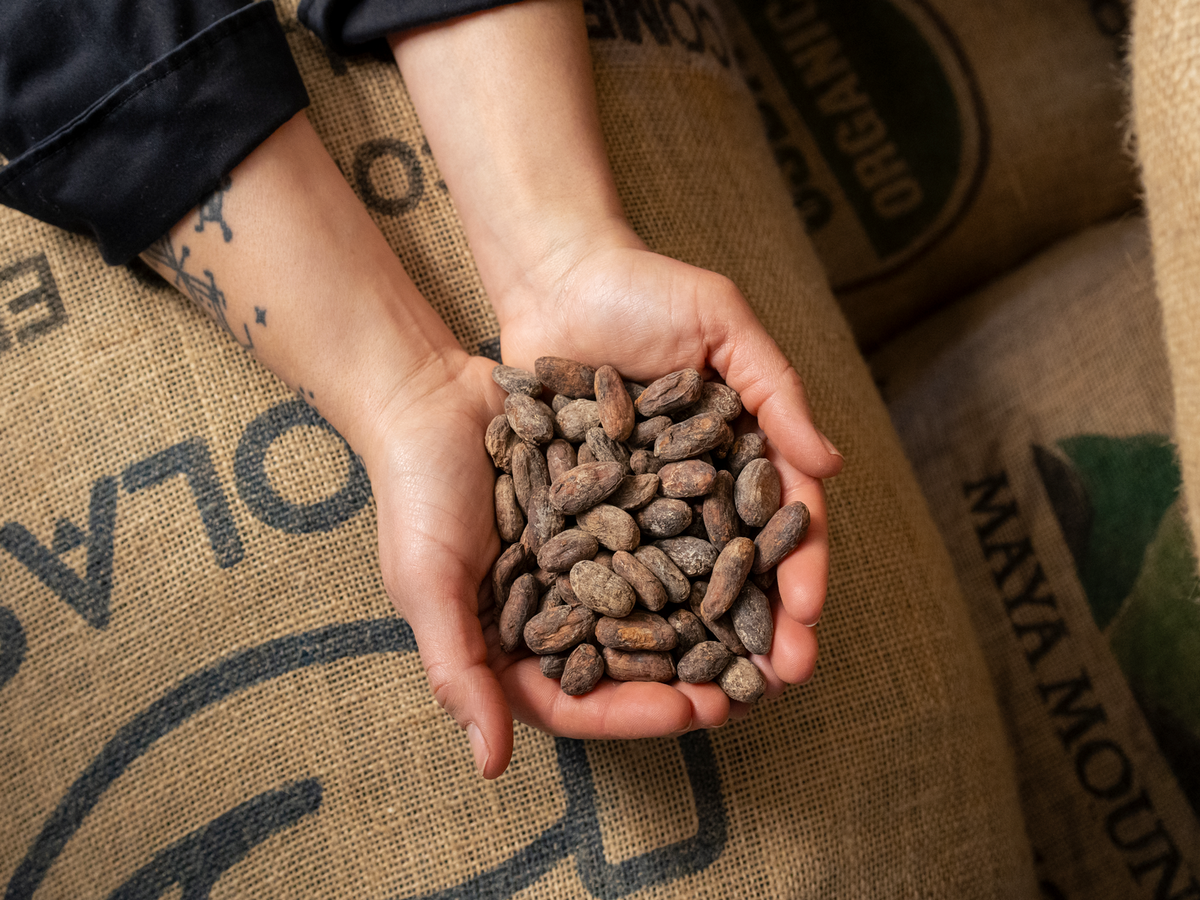
Lot
A unit you can trace, never a vague blend. The batch carries the terroir all the way to the workshop.

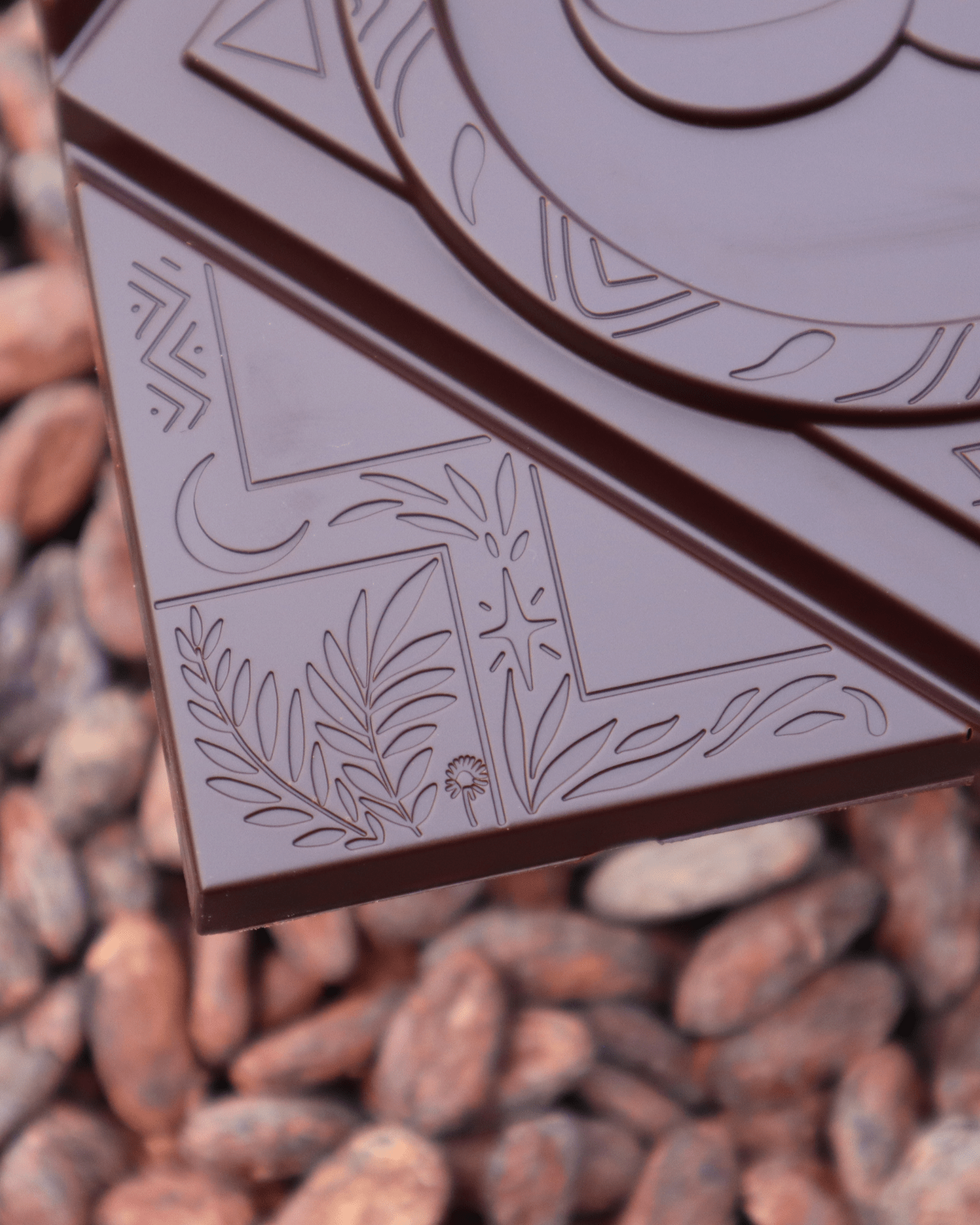
The indulgent bars
Discover our ranges

Our origins
Discover our terroirs

Vegan milk
Majambo, the little known cousin

Guide · Understanding · Chapter 07 / 10
In the boxes, in the sun,
under the stone grinder: the words of cacao follow the substance as it changes.
The words of cacao are not jargon.
Each one names a gesture, or a state of the substance, along a path that begins on the plot and ends in the workshop. Knowing them means being able to read an origin, a label, a tasting note, without being dazzled by the percentage alone.
Here we follow cacao after the pod: over there, fermentation and drying; then, once the beans have reached us, roasting, grinding, refining and tempering. The gestures of our workshop are told in The workshop.

Territory · post-harvest
As soon as the pod opens, the white pulp feeds yeasts, then bacteria. The bean is not yet cacao: it is during these days that its future flavour opens or closes. A good fermentation heats up on its own and can climb towards 53 °C. Fire has nothing to do with it: this is the heat of living things at work, in wooden boxes, in heaps, sometimes in sacks, depending on the place and its habits.
Too short, and the bean stays harsh, green in the mouth. Too long, and it falls flat, turning sour or heavy. This gesture belongs to the land and to those who live there, long before the workshop and the journey.
Territory · post-harvest
When the pulp is spent, the water has to be drawn out without burning what fermentation has opened. Raised beds, patios, sheds: the sun and the air do the work, more or less quickly depending on the season. Too fast, and the shell hardens while the heart stays damp. Too slow, and mould settles in.
Drying does not create flavour: it keeps it, or it marks it. This too is a gesture from over there, hands in the beans as they are turned, eyes on the sky.
Atelier
The beans arrive dry. Before heating them, we listen to them: a batch that is already very aromatic asks for little, a more closed one for a little more. Roasting does not invent an origin. It reveals it, or it flattens it.
With us, this gesture happens in Heks, in an oven you are welcome to come and see. The colour changes, and so does the smell: just compare a bean before and after. Some batches are not roasted, or are roasted low, and that is what we call them, rather than writing “raw”.

Atelier
The shelled bean, the nib, goes under the stone grinder. The cocoa butter, already present in the bean, is released by the friction. The substance becomes a paste, also called liquor. Nothing is added at this point, except sometimes a little cocoa butter, when a batch needs it for the stone grinder to keep turning.
Bean-to-bar means exactly that: from the bean to the bar, without buying in a mass made somewhere else. Under the stone grinder, the terroir stops being a bean and becomes a substance that can still be read.
Atelier
The cacao goes on refining. There is nothing secret about conching: it is time, gentle heat, air. The most volatile acidities leave, the texture lengthens. Too little, and the paste stays gritty, a little green. Too much, and it turns uniform and loses what the terroir had left behind.
There is no single duration. Each batch has its own, and we decide it by tasting, not by following a recipe.

Atelier
Tempering guides the crystallisation of the cocoa butter along a controlled temperature curve. It prepares the sheen, the clean snap and the firmness of the bar.
In Heks, Mounia and Jonathan watch over this stage. The tempered mass is then poured into moulds, cooled, and turned out. What was turning under the stone grinder takes on a form you can hold between your fingers.
A short lexicon
A unit you can trace, never a vague blend. The batch carries the terroir all the way to the workshop.
The paste you get by grinding cacao: the particles of the bean and the butter it naturally contains.
Words for the scents and flavours that cacao evokes on its own: fruit, flower, wood, for example.
Fermentation, drying, roasting, grinding: moments when cacao changes language.Volume 1, MOOJO
See these gestures where we work, in Heks: the oven, the stone grinder, the tempering machine.
The atelier