





Journal · Belize
Maya Mountain
An infrastructure designed to change one link in the system, rather than a slogan on a label.
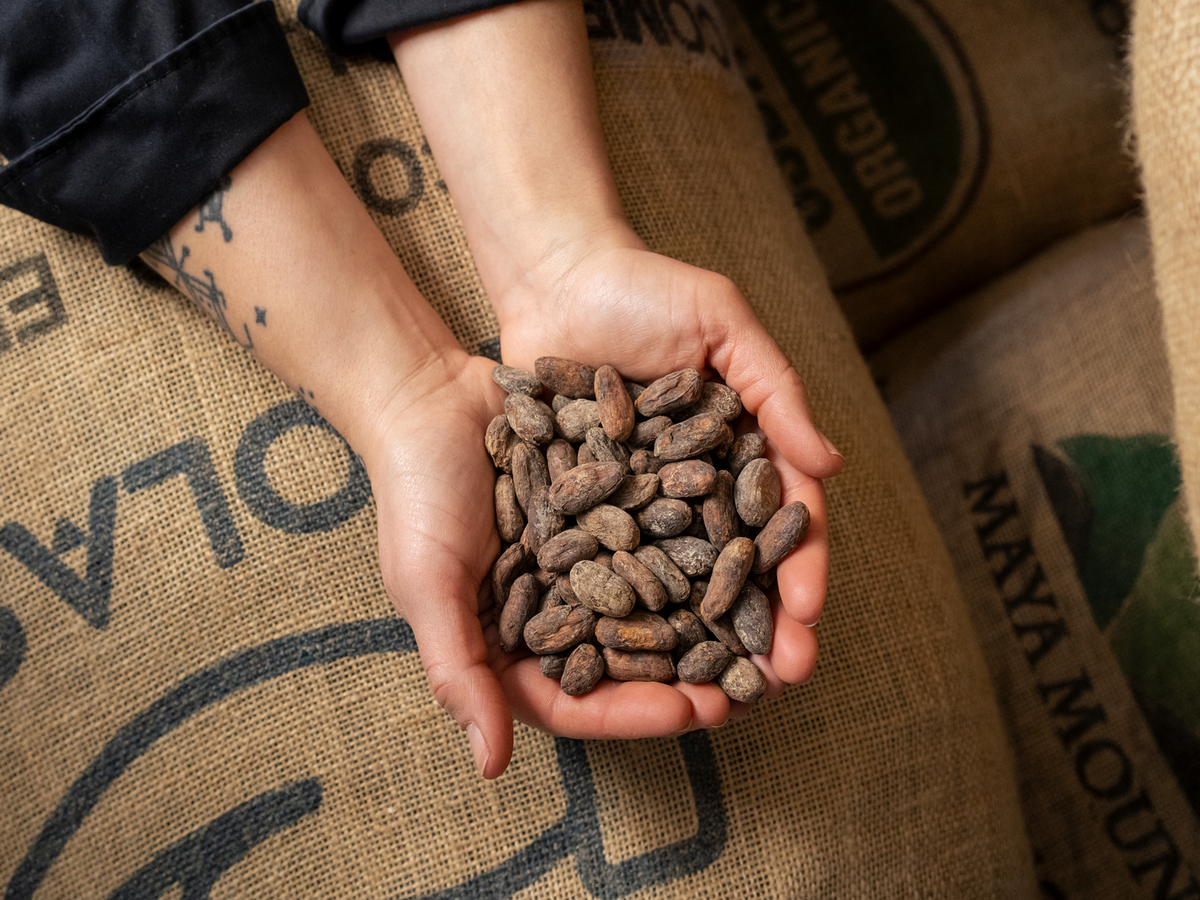
In the Toledo district, in southern Belize, the landscape is made of karst limestone and the edge of low tropical forest. The cacao plots there are almost never on their own: they grow among timber trees, banana trees, mango trees, avocado trees, coconut palms: an agroforestry in fact, where cacao shares the land with everything else, on areas of barely one hectare on average per farm. It is in this territory that the organisation operates which buys and processes the cacao we source under the name Maya Mountain.

Infrastructure
An infrastructure,
first of all
What sets this organisation apart is not first of all a matter of taste or terroir. It is an infrastructure decision. It was the first of its kind in Belize to centralise the fermentation and drying of cacao, with weighing, recording and payment on the very day of delivery.
Concretely: a grower who brings in his harvest does not wait weeks to be paid, and does not handle alone, at home, a technical stage: fermentation, which nonetheless determines a good part of the final quality of the cacao. It is an organisational choice that is simple to describe, and not so simple to put in place: it requires a structure, a place, a cash position, a trust built with every farm in the network.


Timeline
A growth you can date
The organisation was founded in 2010. Its first purchased harvest dates from January 2011: 27 kilos, from 52 families. The network has grown since: the most recent sources, and those closest in time, converge on a figure of around 418 to 420 families today, a number in evolution rather than a ceiling. Higher figures are sometimes seen in circulation; we prefer to stick to this range, the only one the available documentation really allows us to confirm.
The growers concerned belong to the Q'eqchi' and Mopan Maya peoples, brought together today within one and the same network of several hundred families.
What is certified, and what that really certifies
All the growers in the network practise certified organic farming, on a little more than 463 certified hectares, under the body Mayacert. The organisation has also held, since 2015, a heritage designation awarded by the Heirloom Cacao Preservation Fund, which distinguishes cacao varieties judged worth preserving for their genetic and sensory qualities. This designation recognises a varietal preservation effort led by a third-party programme, it does not constitute a genetic certificate covering each exported lot.

Governance
A recent development
In 2025, the growers of this network voted to create a cooperative intended to buy the organisation back from its previous owner: a recent change of governance, which places the tool directly in the hands of the producing families.
That is perhaps the best way to sum up what Maya Mountain represents for us: an origin where the infrastructure, who pays whom, when, and who owns what, counts at least as much as the story that could be told about it.