
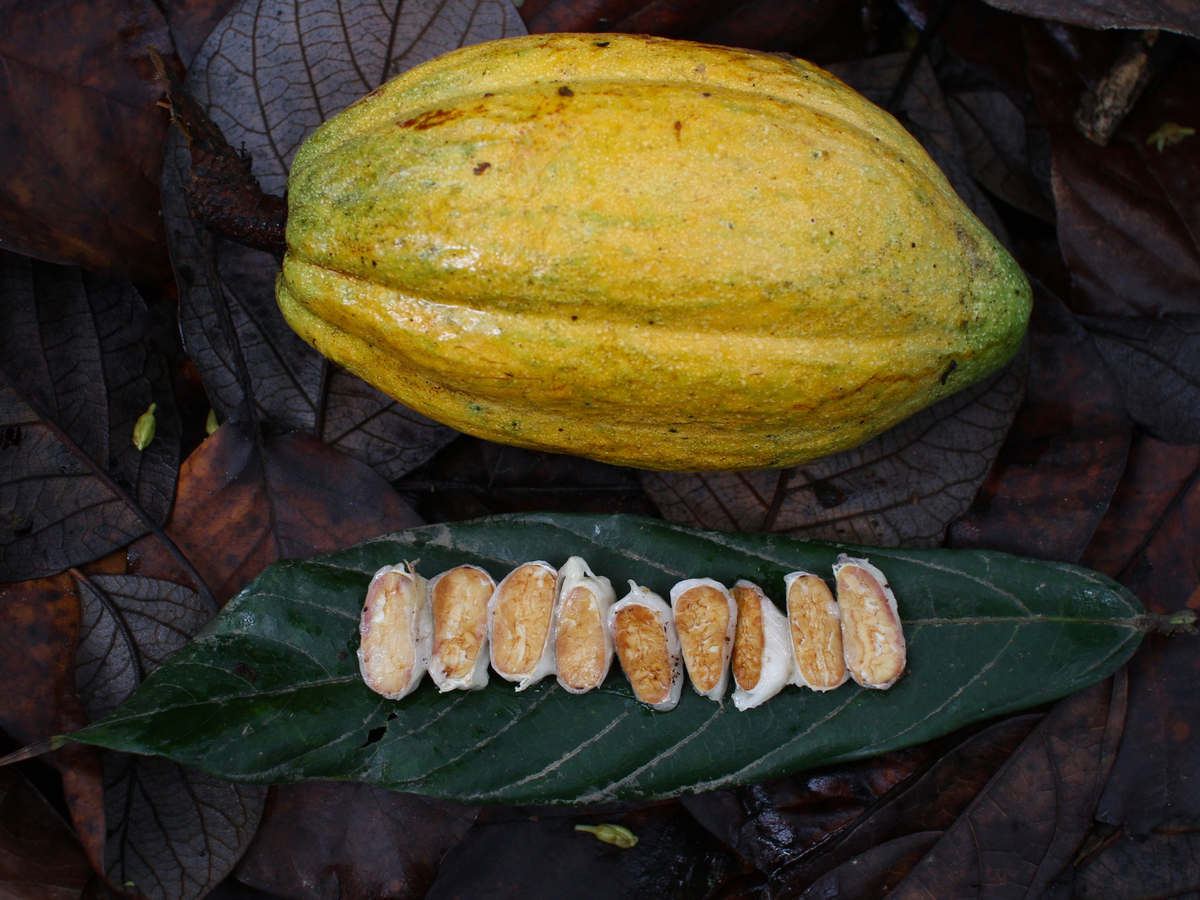

A bean-to-bar day is not an anonymous production line. It is a sequence of slow gestures, in the old light-railway station of Heks, where every decision preserves · or erases · the work of the terroir. Everything happens here, on machines we run ourselves. Nothing is subcontracted.
The eight gestures
- Receiving and checking · the sacks arrive with their lot marking and rest at a held temperature. Each origin stays in its own sack, under its own name.
- Sorting and sieving · stones, fragments, flat or mouldy beans: by hand. A single badly fermented bean marks a whole lot.
- Roasting · or not · in the oven, between 110 and 115 °C, low then, or not at all. A heavy roast builds a house taste that covers the lot; a low roast lets the acidity and fruit of the terroir through.
- Cracking and winnowing · the bean is broken, the shell separated from the nibs by a current of air. Some small lots are peeled by hand.
- Grinding and refining · the nibs go to the stone mill. The cocoa butter held in the bean is released, nothing is added. 48 hours for a pure cacao, 72 for a bar, until the particles can no longer be felt under the tongue.
- Maturing · the mass rests, the aromas settle into place, the acidity comes down.
- Tempering · between 29 and 31 °C for our dark chocolates: the crystal form that makes a bar snap clean and shine. The least forgiving step.
- Moulding and resting · poured by hand, mould after mould, tapped to drive out the bubbles, set to crystallise in the cold. If the bar resists unmoulding, we start again.


None of these steps has a universal setting: a bean from Belize and a bean from Peru have neither the same moisture nor the same shell. So we taste · the bean, the nibs, the mass, the bar · and when the lot no longer recognises itself, we change one parameter and start again.
Go further: The MOOJO workshop · Bean-to-bar bars.


