
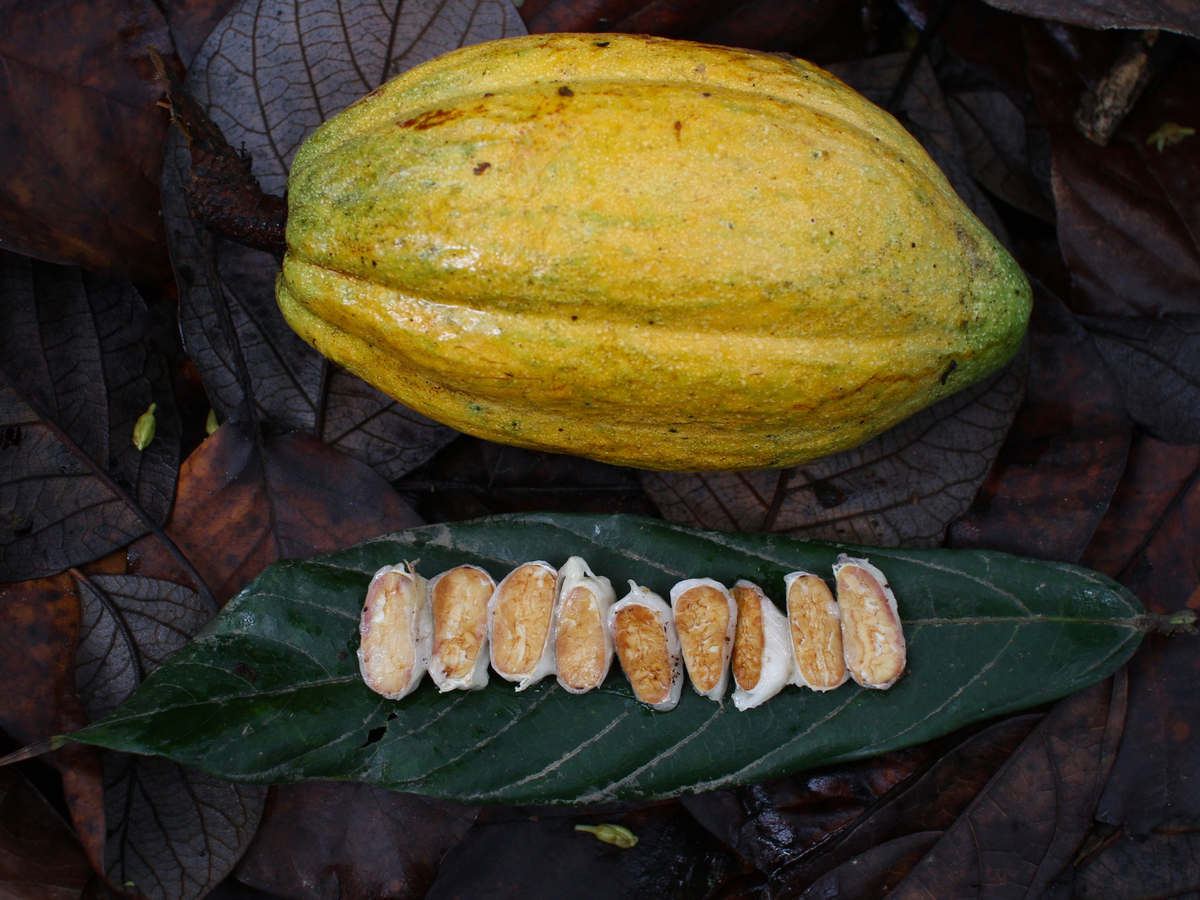
For many of us, cacao immediately brings chocolate to mind: a bar, a praline, a hot drink, a shared dessert. Yet chocolate is only one of the possible forms of cacao · and not the first.
Long before bars and the chocolate industry, cacao existed as a fruit, a tree, a crop and a drink. It belonged to landscapes, to communities, to gestures passed down. That is where we start, in Heks, every time a sack of beans reaches the workshop.
It all begins in a fruit
Cacao is not born in a factory. It grows in tropical forests, in the shade of other trees, in living soils, to the rhythm of the rains and of human work.
The pods grow straight out of the trunk and branches of the cacao tree. When ripe, they hold dozens of beans wrapped in a white pulp, sweet and tart. Opening a fresh pod for the first time, nothing yet recalls chocolate: the pulp suggests lychee, pineapple, citrus or passion fruit; the beans themselves are green, bitter, astringent. At that stage chocolate does not exist. There is only living material, and a great many possibilities.
The white pulp, where the taste comes from
We picture cacao brown. Its story nonetheless begins in white. During fermentation, the pulp around the beans feeds yeasts and then bacteria; it heats, breaks down, drains away, changes its smell and its role. What looks like a simple wrapping is the engine of a deep transformation.
Without that pulp, no fermentation; without fermentation, most of the aromas we later look for in the cup would never appear. It is a lesson we keep in mind with every lot: what you taste often comes from what you can no longer see at the moment of tasting · the tree, the soil, the climate, the pulp, the time, the hands that sorted.
A material that changes
A fresh bean does not become cacao by magic. It goes through a series of steps that change its structure, its smell, its colour and its aromatic potential.
After the harvest and the breaking of the pods comes fermentation: the beans, still in their pulp, are laid in boxes or tubs, depending on the region. Over several days the temperature rises. Yeasts, lactic and acetic bacteria transform the pulp and set off reactions inside the bean. This step does not yet give chocolate; it creates the conditions for it to appear. It turns a raw bitterness into a material capable of revealing fruity, floral, honeyed, spiced and woody notes.
Then comes drying. Too fast, and it locks defects in; too slow, and it weakens the bean. Well handled, it stabilises what fermentation opened up.
Only later come roasting, shelling, grinding, maturing, tempering. At each of these steps you can reveal or mask; at every moment you have to choose · push, slow down, wait. Our work is not to manufacture an identity. It is to understand what the material allows, and to accompany it without covering it over.

Cacao before chocolate
The chocolate we know is a recent invention in the long history of cacao. Before being moulded into bars, mixed with sugar or worked into pralines, cacao was for a long time a drink.
In Mesoamerican cultures it held several roles at once: food, currency, offering, sign of hospitality, presence in shared moments. It did not come down to sweet pleasure.
Arriving in Europe, its history changes. Sugar, spices, milk, then industrial techniques reshape how it is seen; little by little, cacao disappears behind chocolate. That evolution produced magnificent craft, and we are part of it. But it created a lasting confusion: we believe we know cacao because we know chocolate.
Cacao is wider than that. It can be a drink, a paste, a bar, an ingredient, a morning gesture, an origin, a raw material. Chocolate is one possible destination, not the point of departure.
A bar is not the cacao
Saying that a bar is cacao is a little like saying that a bottle of wine is a grape. It is true, and it is incomplete.
Between the fruit and the finished product there is a terroir, a variety, a harvest, a fermentation, a drying, a journey, a roast, a grind, a maturing, a gesture. The bar expresses a material; it does not sum it up.
That is why two bars at the same percentage can offer radically different experiences. One 100 % can be round and fruity; another intense and tannic. A 75 % can seem more bitter than a 100 %, depending on the origin, the fermentation and the processing. The percentage states a proportion. On its own it says nothing about the quality of the bean, nor about the care taken in working it.
At MOOJO the bar counts and the cup counts. But they are the visible forms of a longer story.
The taste of the place
In wine, nobody is surprised to hear talk of terroir. In specialty coffee, it is accepted that an altitude, a variety, a process change the cup. For cacao, that reading is only starting to spread.
Yet cacao expresses the place too: the soil, the climate, the altitude, the shade, the neighbouring trees, the farming practices. Genetics play their part. A Criollo Blanco from Mexico does not tell the same story as a cacao from Semuliki in Uganda, as a Nacional from Ecuador, or as a cacao from the Alta Verapaz in Guatemala.
But terroir does not stop at the soil. It includes the gestures: the same bean changes face according to the fermentation, the drying time, the roast, the way it is ground. Terroir is a conversation between nature and culture.


Tasting notes are not added flavourings
One confusion keeps coming back: when we speak of red fruit, olive, jasmine, honey or nuts, some people think those aromas have been added. They have not.
Tasting vocabulary serves to describe what the material evokes on its own. As with wine, coffee or olive oil, the notes are sensory landmarks: they put words on an experience. A cacao can evoke banana without containing banana, recall flowers without flowers, suggest honey without sugar. Those nuances come from the variety, the fermentation, the drying, the roast, the grind.
That is what makes cacao so absorbing: worked with respect, it needs no flavourings to be complex. It already carries a landscape.
What we make of it
MOOJO was born in 2012, on the Ucayali, out of an encounter with cacao as it is prepared and shared; today it is made in Heks, in the old light-railway station, lot by lot. Cacao is not an ingredient for us. It is the meeting point between a forest, growing families, a workshop and a cup.
Preserving that link does not mean leaving the material untransformed. Transformation is necessary; it has to be carried out with listening. Roasting is revealing, not dominating. Grinding is opening a texture, not levelling it. Tempering is giving cacao a stable, practical and beautiful form · not industrialising it.

In the world of ceremonial cacao, a raw or irregular look is sometimes presented as more authentic. We do not believe that. Authenticity lies in the relationship with the material, in transparency about the origin, in care for the process. A smooth, glossy, tempered bar can be deeply faithful to the cacao, if it starts from a material that was respected · no sugar, no milk, no flavouring, no additive. The form does not cancel the ritual; it makes it accessible and stable.

Cacao as a link
A cup of cacao is never only a cup. It can be a pause, a morning gesture, a presence in a circle, a link with an origin, a way of slowing down or of sharing.
But that link must not turn vague. Cacao connects because it comes from somewhere, because someone grew it, because it went through real steps and because it asks for time. The ritual, if there is one, begins well before the cup: in the soil, the pod, the fermentation, the fire, the grind.
Cacao feeds more than the body, but it should not be made to say just anything. Its strength comes from being anchored. It does not need to be loaded with promises; often it is enough to prepare it with attention.
Looking at cacao differently
Next time you prepare a cup or break a square off a bar, take a moment before tasting. Follow the thread back: the fruit, the white pulp, the beans fermenting, the days of drying, the hands that sort, the sack that travels, the workshop, the roast, the turning mill, the material becoming paste.
Then chocolate may stop being a full stop and become a door again · towards the fruit, the forest, the gesture, the terroir. And you will understand why, at MOOJO, we talk as much about cacao as about chocolate. Chocolate matters. Cacao is wider.


